Efficient Seed Distribution: What Drone Spreading Brings to UK Farms
Rethinking How We Put Seed in the Ground
For years, the standard way to establish a crop was to pull a seed drill behind a tractor, row after row, often when the soil was dry enough to travel. That approach works, but it has limits. Wet autumns, heavy clay, and the need to get cover crops in quickly after harvest can turn a simple drilling job into a race against the weather. I have seen fields where the drill sank axle-deep and the seed went in at uneven depth, and I have also seen the same field flown over with a drone in a couple of hours, seed broadcast evenly across the surface, with no soil compaction at all.
The shift toward aerial spreading is not about replacing the drill entirely. It is about adding a tool that fits the messy, unpredictable reality of farming. When you need to cover ground fast, reach awkward corners, or work ground that is too wet for wheels, a drone can be the difference between getting a crop established and missing the window altogether. That is what makes efficient seed distribution such a practical goal on a modern UK farm.
Why Speed and Precision Matter More Than Ever
Timing drives most seed decisions. A cover crop sown in late August will build more soil organic matter and hold more nitrogen than the same seed sown in October. A grass ley undersown into standing wheat needs to go in at exactly the right growth stage. Every day of delay costs yield and soil health. A drone can cover 10 to 15 hectares an hour with a hopper full of seed, flying a precise pattern that avoids overlaps and gaps. That speed is not just convenient; it opens windows that ground equipment simply cannot use.
The other side is precision. With GPS Guidance and RTK Correction, a drone can place seed within centimetres of the intended line. That matters when you are overseeding a thin pasture or stitching legumes into an existing sward. You can set the swath width to match the seed type and the spreader settings, and the flight planning software will handle the rest, turning automatically at the headland and logging exactly where each kilogram of seed went. That level of control is hard to achieve with a spinning disc spreader on a rough track.
Precision Agriculture is not just about yield maps and variable rate nitrogen. It is also about applying inputs only where they are needed and at the right rate. With Variable Rate Seeding, you can adjust the seed rate on the fly, based on a prescription map that reflects soil type, moisture, and yield history. A drone can follow that map just as easily as a tractor, sometimes more accurately because it does not have to deal with wheel slip or uneven ground. The result is a crop that is more uniform, with fewer wasted seeds and less competition between plants.
Beyond the Drill: Where Aerial Seeding Fits
Broadcast Seeding has a bad reputation in some circles, mainly because uneven application leads to patchy establishment. But with a drone, the spreading pattern is so consistent that broadcast seeding becomes a viable option for many crops, especially cover crops and grass leys. The seed lands evenly, and as long as it gets good seed-to-soil contact, germination is often better than you would expect. I have seen oilseed rape flown on in September, and it established as well as drilled seed on the same farm.
No-till Farming and reduced tillage systems are a natural fit for aerial seeding. When you are trying to build soil structure and avoid disturbing the soil, the last thing you want is a heavy drill running through it. A drone can sow into standing stubble or a living cover crop without touching the ground. That is how many farmers are now establishing companion crops in maize, or sowing a cover crop into a standing crop of wheat just before harvest. The drone flies over the crop, drops the seed, and the next rain works it into the surface.
Seed Drilling still has its place, especially for large areas of combinable crops where precise depth is critical. But for small parcels, awkward shapes, and fields that are too wet for wheels, aerial spreading is often the only practical option. It also works well for reseeding hills and steep slopes where a tractor is dangerous. I have spoken to upland farmers who use drones to spread grass seed on ground they would not dare take a vehicle across.
The Equipment Behind the Job
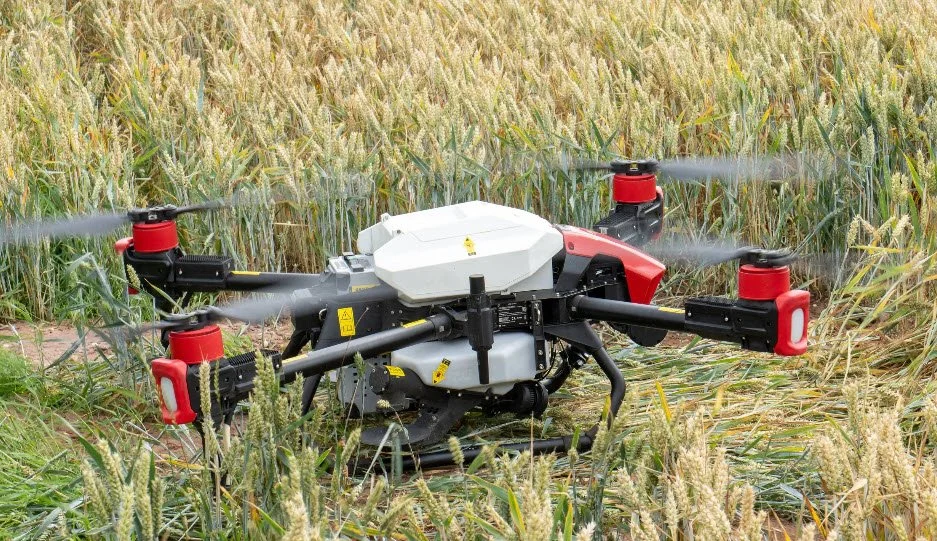
The hardware has come a long way in a few years. The DJI Agras range, including the Agras T30, is the most common platform in the UK for this type of work. These are not toys. They are serious agricultural machines with payloads of 30 litres or more, dual atomised spray systems, and radar and vision sensors that let them fly close to the ground and avoid obstacles. The Agras T30 can spread seed at a rate of up to 40 kilograms per minute, and the spreading disc throws the seed in a wide, even pattern. With the right settings, you can achieve a coefficient of variation that rivals a conventional spreader.
The flight planning software is where the real intelligence lives. You draw the field boundary on a map, set the rate, and the software works out the flight lines, the turn points, and the amount of seed to release at each point. It also handles the battery changes, which are the main bottleneck in any drone operation. A typical mission lasts about 10 to 15 minutes, then you swap the battery and the hopper, and the next load goes out. With two or three batteries and a fast charger, you can keep the drone in the air for most of the day.
For those who want to go further, there is DroneSeed, a US-based company that uses swarms of drones to replant forests after wildfires. Their approach shows what is possible when you combine precision spreading with large-scale logistics. In the UK, the technology is being adopted more for agricultural crops than forestry, but the principle is the same: get the seed where it needs to go, quickly and accurately.
Working with Regulators and the Landscape
Flying a drone over your own land for your own benefit is one thing. Offering a service to other farmers is another. In the UK, commercial drone operations are regulated by the Civil Aviation Authority, and you need permission to fly beyond visual line of sight if you want to cover large areas efficiently. That is a hurdle, but not an impossible one. Many drone service providers operate under a permission that allows them to fly within a defined area, and they work closely with the landowner to keep the operation safe and legal.
The Rural Payments Agency and Natural England are also part of the picture, especially if you are using drone spreading for environmental schemes. For example, if you are establishing a wildflower margin or a nectar strip under a Countryside Stewardship agreement, the seed must be sown at a certain rate and at a certain time. A drone can do that precisely, and the flight log provides evidence of what was sown and where. That can be useful when it comes to claiming payments.
Seed Quality and the Little Details
Efficient seed distribution is not just about the machine. The seed itself has to be fit for purpose. Seed Coating, which is a thin layer of polymer or clay around the seed, can make a big difference to how seed flows through the drone's spreading mechanism. Coated seed is heavier and more uniform in size, which means it spreads more evenly and is less likely to bridge in the hopper. It also can carry a Legume Inoculant, which is essential for legumes like clover and lucerne. The inoculant needs to stay alive and in contact with the seed, and a coating helps with that.
I have seen farmers try to save money by using cheap, uncoated seed, only to find that the drone's spreader cannot handle the variable seed size. The result is a patchy sward and a wasted season. A little extra cost on seed coating is often the cheapest insurance you can buy.
Weighing the Trade-Offs
No single method is right for every situation. Drilling gives you better depth control and seed-to-soil contact, which is crucial for some crops. Aerial seeding is faster and less soil-disturbing, but it relies on rain or irrigation to get the seed into the ground. On light soils, a light rain after spreading is enough. On heavy clay, you may need to roll the field to get good contact. That is where experience comes in. You have to judge the conditions and decide whether the window is right.
For those who are new to drone spreading, I would suggest starting small. Try it on a cover crop or a grass ley, where the cost of failure is low. Learn how the drone behaves in different wind conditions and how to adjust the rate for different seed sizes. Once you see how even the distribution is, you will understand why efficient seed distribution is becoming so popular.
The Future of Spreading
The technology is still evolving. Battery life is improving, and the next generation of drones will carry even larger payloads. There is also work on integrating drone data with farm management software, so that the seed map from the drone feeds directly into your yield monitor. That kind of feedback loop is the heart of Precision Agriculture. It turns a simple seeding operation into a data-rich exercise that informs every future decision.
In the meantime, the practical benefits are already here. Faster establishment, better use of weather windows, less soil compaction, and more accurate application. For UK Agriculture, where margins are tight and the weather is unpredictable, that is a combination worth taking seriously.
If you are thinking about using a drone for spreading, talk to someone who has done it. Ask about the settings, the battery life, and the paperwork. Then go out and watch one fly. Once you see the seed landing in a perfect, even carpet, you will understand why so many farmers are making the switch. The goal is not to replace the drill, but to have another option in the toolbox. And with the right approach, efficient seed distribution can be exactly what your farm needs.
