Why do Viking raids dominate screen stories when trade mattered too?
A Viking ship appears on screen and we know what is coming. The sail fills, shields line the gunwale, and a settlement on the shore becomes a target. Within seconds, a story has its conflict, its danger and its dramatic promise. That is the power of the raid: it is instantly legible.
But it is also a partial picture. Viking-Age Scandinavians travelled to raid, certainly, but also to trade, settle, farm, negotiate and explore. Their ships linked communities across the North Atlantic and the Baltic, and reached into river systems running through eastern Europe. Those journeys could carry weapons and warriors; they could also carry wool, timber, furs, glass, silver and people. The same vessel might serve more than one purpose over the course of a voyage.
So why do screen Vikings so often arrive as attackers rather than merchants? The answer has less to do with what mattered most in everyday life than with what makes a story easy to read at a glance.
The raid narrative shortcut
A raid gives a writer a ready-made plot engine. There is a clear division between attackers and defenders, a location under threat, and a clock that starts ticking as soon as the sails appear. The audience does not need a long explanation of local politics or the terms of a trading agreement. The stakes are visible in the burning hall, the fleeing villagers or the line of shields at the beach.
This is the raid narrative shortcut: a complex history condensed into a single, forceful image. It works especially well in trailers, opening scenes and action sequences. It also helps explain why the raid is repeated so often. A trading voyage can be full of drama, but its tensions may depend on trust, prices, language and changing alliances—things that take time to establish. A raid announces conflict immediately.
The shortcut can distort the subject if it becomes the whole story. When every arrival means an attack, audiences may come away imagining Viking-Age Scandinavians as a society organised only around violence. In reality, raiding was one activity among several, and the balance varied by person, place and period. Some people travelled; others stayed home and worked farms or crafts. Many encountered Viking travellers as neighbours, customers or settlers rather than as invaders.
Ships: the most useful image, and the easiest to misread
Viking ships are cinematic gifts. Their long, low profiles look elegant against open water, while their sails provide a strong graphic shape. A ship can announce a journey, a raid, an escape or an arrival in a new world. It can also carry an entire community of characters into the next chapter.
https://historymedieval.com/vikings-on-screen-history-myth-and-gaming/
Yet the ship is more than a war machine. The phrase ships as contact not just war is a useful corrective: ships connected people. Their flexibility allowed crews to cross seas, follow coasts and travel up rivers. That mobility helped make raiding possible, but it also made exchange and settlement possible. A ship entering a harbour might be bringing goods to sell, news to share, relatives to meet or people looking for a place to live.
The physical form mattered, too. Different vessels served different tasks, and not every ship should be treated as a sleek longship packed with warriors. Cargo vessels were essential to the movement of goods. Screen stories often make the longship stand in for every kind of travel because it is visually distinctive, but a busy trade route would involve more than one type of boat and more than one kind of passenger.
That distinction can be communicated without slowing a scene down. Show bales and bundles being weighed, a crew waiting for a market to open, or a ship being unloaded beside a settlement, and the audience understands that travel is not automatically an attack. A single ship can still carry tension: will the exchange be fair, will the agreement hold, and who has the power to set the terms?
Trade is a network, not a quieter version of a raid
The phrase trade networks vikings points to something larger than a market stall or a chance deal. Viking-Age commerce connected Scandinavian communities with places around the North Sea and Baltic, and with routes that reached far beyond them. Goods, skills and information moved along these connections. People could travel the same routes for different reasons, and an object might pass through several hands before reaching its final owner.
Archaeological finds help make this less abstract. Coins from distant regions, weights used in measuring, imported materials and evidence of craft production all speak to movement and exchange. They do not, by themselves, tell us that every traveller was peaceful or that every transaction was fair. Trade could involve coercion and inequality; captives could be bought and sold. The point is not to replace a simple story of violence with a simple story of harmony, but to recognise that Viking-Age life operated through many kinds of contact.
For screenwriters, trade offers conflicts that are different from a beach assault. A merchant may be caught between rival leaders. A settlement might depend on a seasonal market. A deal could fail because someone has used false weights, or because a new ruler imposes a toll. These stories need not be less dramatic; they simply ask the camera to linger on gestures and relationships rather than on flames and swordplay.
Games and film establish a world at different speeds
Film and television usually have limited time to teach viewers how a world works. A few strong images must do a lot of work. A ship, a round shield and a settlement can establish “Viking” in a moment. Add a raid, and the setting’s danger is clear. This visual efficiency is one reason familiar symbols survive even when they flatten historical variety.
Games have a different opportunity. Players spend longer in a world and can learn its systems through repetition. A settlement can become a place to return to; a trading post can offer new goods, information and relationships. A game can make travel itself meaningful by asking players to manage cargo, choose routes or decide whether a meeting should be handled by bargaining or force. In that sense, games can give trade more space than a film’s opening sequence can.
But games also have their own shortcuts. Combat is easy to turn into a repeatable activity, while trade can become a menu, a resource counter or a brief stop between battles. A rich historical setting does not automatically make a rich historical story. The question is what the player is encouraged to notice. If every settlement is mainly a target or a supplier of upgrades, the world still feels organised around violence, even when the plot mentions commerce.
Story form What it can establish quickly What it can give trade Film or television Conflict, threat and a recognisable visual setting Meaningful scenes of negotiation, markets and changing alliances Games Repeated travel, settlements and player goals Systems for cargo, routes, exchange and relationships
Neither medium is automatically more accurate. Both make choices about pace and emphasis. A film can make a negotiation riveting; a game can reduce an entire trading network to a button marked “sell”. The useful question is not whether a story includes merchants, but whether it lets exchange shape the world rather than merely decorate it.
The horned helmet myth: a costume with staying power
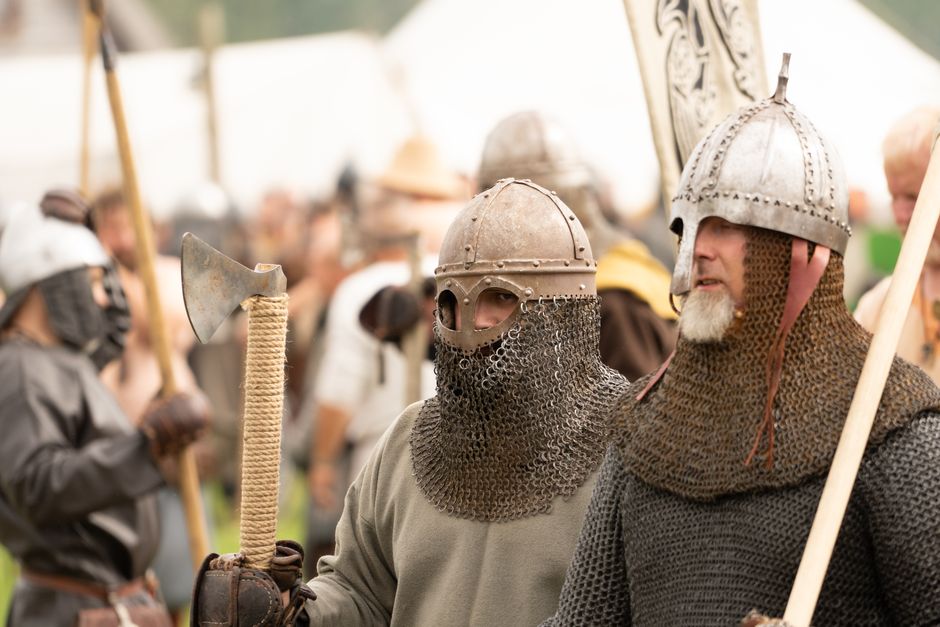
No Viking screen image is more instantly recognisable—or more misleading—than the horned helmet. The problem is not that horns are impossible to imagine on any headgear in history; it is that the familiar horned “Viking helmet” is not supported by archaeological evidence for Viking warriors. Practical combat headgear would not benefit from projecting horns that could catch or deflect blows in dangerous ways.
So why does the image persist? Part of the answer is visual clarity. Horns make a silhouette unmistakable, even at a distance or on a small screen. They turn a person into an emblem of northern, wild and supposedly primitive power. The image also belongs to a long history of later costume and illustration, rather than to a straightforward record of Viking-Age equipment. Once it became popular, each new production could borrow it as shorthand for “Viking” without having to explain itself.
That is why correcting the myth is not simply a matter of taking horns off a costume. The horned helmet tells us about how later audiences wanted Vikings to look: exotic, ferocious and outside the familiar rules. It is a good example of a visual tradition becoming more influential than the material evidence it claims to represent.
Gjermundbu: a reality check in iron
The Gjermundbu helmet offers a more grounded point of comparison. Found in a rich burial at Gjermundbu in Norway, it is the best-known surviving Viking-Age helmet and the only substantially complete example from the period. Dated to the tenth century, it has an iron cap and a protective face covering with a distinctive spectacle-like form around the eyes and nose. There are no horns.
That does not mean every Viking wore a helmet like it. Archaeological survival is uneven, and helmets were costly equipment; the Gjermundbu find cannot stand in for every region, rank or moment across the Viking Age. It is a reality check, not a complete catalogue. Still, it gives artists and costume designers something tangible: a practical piece of protective gear, shaped around the needs of the face rather than around a modern appetite for spectacle.
For viewers, it is a reminder that accuracy need not make a design dull. The real object has its own striking character. Its eye guards give it an unusual expression, and its construction invites questions about who owned it and how it was used. Removing the horns does not remove the story; it makes room for a more interesting one.
What a fuller Viking story might look like
A richer screen world does not have to abandon raids. Raiding mattered, and stories should not disguise its violence. But a broader visual vocabulary can place that violence alongside other kinds of life. A settlement can be a home, a workshop and a trading stop, not only a future battlefield. A ship can carry cargo as well as fighters. A shield can be a practical object, a communal sign or a symbol of danger, depending on the scene.
Writers and designers can ask a few straightforward questions:
- Does every ship arrival lead to violence, or can arrival also mean exchange or migration?
- Do settlements have everyday life beyond their role as targets?
- Can commerce create conflict, obligation and change—not just provide money or equipment?
- Are familiar costume symbols being used because the evidence supports them, or because audiences recognise them?
Those questions are useful whether you are watching a prestige drama, exploring a game or reading a popular-history article. Readers browsing HistoryMedieval, Mr Q or MrQ can bring the same curiosity to the images and claims they encounter: what is being shown, what has been left out, and what kind of story does that choice encourage? The names may appear in very different contexts, but historical media benefits from a habit of checking the visual shorthand against the evidence.
Beyond the burning shoreline
Raids dominate because they are immediate, visual and narratively efficient. They turn movement into threat and history into a clash that needs no introduction. Trade asks for more patience, but it offers a wider view: of connected places, practical decisions and relationships that might be cooperative one day and dangerous the next.

Keeping both in view makes the Viking world more compelling, not less. The ship approaching the shore need not be a single-note symbol. It can be a warning, a welcome, a business opportunity or all three at once. If we remember that ships as contact not just war, the story gains room for the full range of Viking-Age lives—and for drama that does not always end in flames.
Share or save this article
Use the Print Article option—via your browser’s PDF/print function—to save a copy for later. You can also use the Facebook share option to pass it along to someone interested in Viking history on screen.
