Budgeting for multimodal AI API usage
Budgeting for multimodal AI API usage is the process of estimating and controlling the cost of sending media inputs and receiving media outputs through an API that handles more than one kind of data, such as text, images, video and audio. The cost depends on the specific model used, the size and resolution of the input, the length and complexity of the output, and the pricing structure of the provider. Because multimodal APIs combine several generation tasks into a single interface, their billing can be more complex than that of a text-only API. Understanding the main factors that drive cost helps users plan their spending and compare services on an equal basis.
Components of cost
Most multimodal AI APIs charge separately for each type of media processed. A single request that sends an image and asks for a text description incurs a cost for the image input and another cost for the text output. If the same request also generates an image, that third operation adds its own fee. The total for a given workflow is the sum of the per-operation charges.
Input cost
Input cost is determined by the size and quality of the media sent to the API. For images, the key factors are resolution and file size. Higher-resolution images contain more data and are more expensive to process. Some providers also charge based on the number of images in a batch. For video, the duration, frame rate and resolution all affect the cost. A longer video at a higher resolution costs more than a short clip at a low resolution. Audio input follows a similar pattern: longer recordings and higher sampling rates increase the cost. Text input is usually measured by the number of tokens, which roughly correspond to words or subwords.
Output cost
Output cost covers the media that the API generates. Text output is again billed by token. Image generation and audio generation are typically priced per output, with the cost scaling by resolution, duration or quality settings. A video generation API often charges by the length of the generated clip, the resolution, and the number of frames. Some providers also add a surcharge for high-detail or slow modes that produce better results. The cost of a single output can therefore vary widely depending on the parameters chosen.
Additional fees
Some APIs add fees for features such as cacheing, queuing or higher priority in the generation queue. A user who needs faster responses may pay a premium for priority processing. Others charge for storing generated media on the provider's servers or for downloading it multiple times. A few services impose a minimum spend per request or per month, which can affect the effective cost for low-volume users.
Pricing models
Providers use several pricing models for multimodal APIs. The most common is pay-per-request, where each API call is billed based on the operations it contains. A second model is token-based, where all inputs and outputs are converted into a common token count, and the user is charged a single rate per token. A third model is subscription-based, where the user pays a fixed monthly fee for a certain number of requests or a certain amount of processing time. Some providers offer volume discounts for high usage, while others have a flat rate regardless of volume.
The choice of pricing model affects how easy it is to budget. Pay-per-request models are transparent but can produce unpredictable bills if usage spikes. Token-based models simplify comparison between different types of media but may obscure the true cost of a video generation API relative to an image generation API. Subscription models cap costs but may include unused capacity.
Key variables that affect cost
Several variables can be adjusted to control spending. The most influential is the choice of model. Different models within the same API family have different price points. A smaller, faster model usually costs less per request than a larger, more capable one. Resolution and duration are the next most important levers. Reducing the resolution of generated images or the length of generated videos can cut costs significantly. The number of output variants also matters: generating multiple candidate images or videos multiplies the output cost by that count.
Another variable is the aspect ratio of generated media. Some APIs charge a premium for non-standard aspect ratios that require additional processing. The generation queue can also be a factor: some providers offer a lower-cost mode that places requests in a slower queue, which reduces the price per request at the expense of longer wait times.
Batch processing
Many APIs allow users to submit multiple inputs in a single batch. Batching can reduce the per-item cost because the provider amortises the overhead of processing the request across many items. However, not all providers offer a batch discount, and those that do may impose a minimum batch size. Batching is particularly useful for workflows that require many small inputs, such as generating descriptions for a library of images.
Comparing providers
When comparing multimodal API providers, it is necessary to look beyond the headline price per token or per request. The same workflow can cost very different amounts depending on how each provider measures resolution, duration and quality. A provider that charges by pixel count may be cheaper for small images but more expensive for large ones. A provider that charges by the second of video may be cheaper for short clips but more expensive for long ones. Some providers include certain features in the base price, while others charge extra for them.
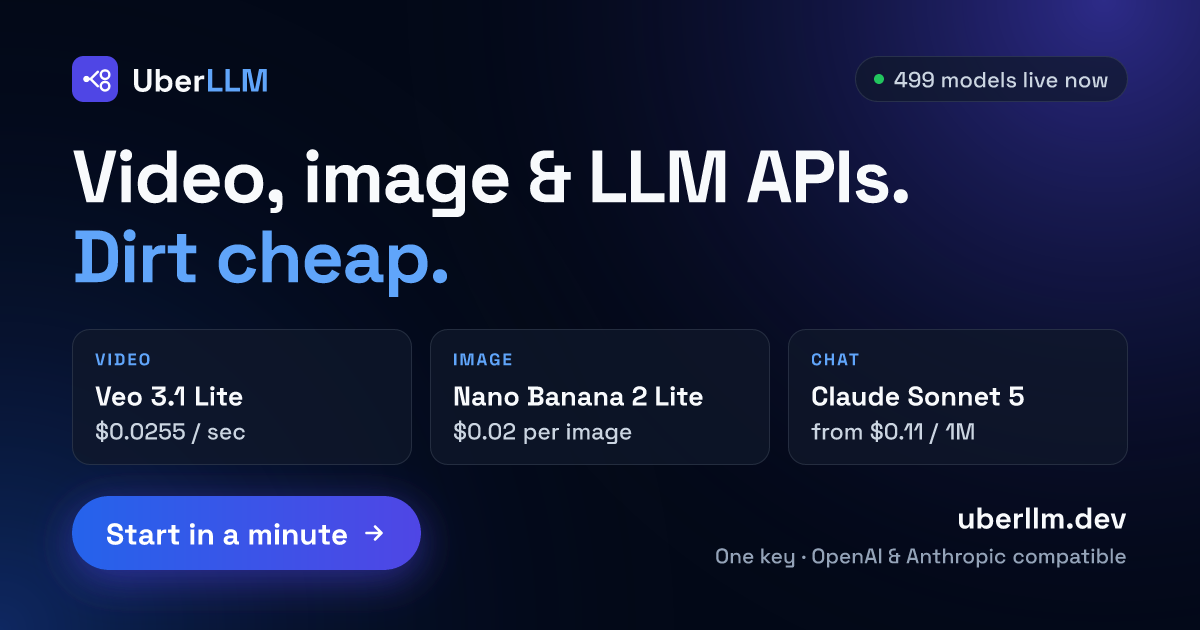
The compatibility of the API with existing tools also matters. An API that supports the same interface as a widely used provider, such as OpenAI or Anthropic, can be used with existing client libraries and workflows without modification. This can reduce development time and avoid the need to rewrite code. The site context for this article mentions that UberLLM offers such compatibility, but the details of its pricing are not relevant to a general reference entry.
Common pitfalls
One common mistake is underestimating the cost of input media. Users often focus on the cost of generating output and forget that sending a high-resolution image or a long video as input also incurs a fee. Another pitfall is not accounting for retries. If a request fails or produces an unsatisfactory result, the cost of the failed request is still charged. Some providers do not refund failed requests, so repeated attempts can inflate the budget. A third pitfall is ignoring the cost of background operations, such as resizing images or converting formats, which some APIs perform automatically and bill as separate operations.
Estimating usage
To budget effectively, a user should first estimate the expected number and type of requests per month. This estimate should include the resolution and duration of media inputs and outputs. The next step is to obtain the pricing sheet from each provider and calculate the cost of a typical request manually. Many providers offer a playground or a test mode that allows users to run a few free requests and see the actual token counts and costs. Running a small set of representative requests can validate the estimates and reveal hidden charges.
For workloads that involve a video generation API, the cost can vary dramatically based on the length and resolution of the generated clip. A short, low-resolution video may cost a fraction of a long, high-resolution one. Estimating the distribution of video lengths and resolutions in the expected workload helps produce a realistic budget.
Monitoring and adjustment
Once an API is in use, monitoring actual spending against the budget is essential. Most providers offer dashboards that show usage and cost in real time. Setting alerts at certain spending thresholds can prevent surprise bills. If costs exceed the budget, the user can adjust the parameters described above: switch to a cheaper model, reduce resolution or duration, or batch requests. Some APIs also allow setting hard caps on spending per day or per month, which automatically stop further requests when the cap is reached.
The process of budgeting for multimodal AI API usage is iterative. Initial estimates are refined as actual usage patterns become clear. Over time, the user gains a sense of which settings provide the best balance of quality and cost for their particular use case. The goal is not to minimise cost at all costs, but to achieve predictable spending that aligns with the value derived from the API.
